
Bethany Bible Church Sunday Sermon Message
September 28, 2025
2 Timothy 2:3-7
Theme: We need to follow the examples of a soldier, a runner, and a farmer in our endurance for the gospel.
(All Scripture is taken from The New King James Version, unless otherwise indicated).
Click HERE for the audio version of this sermon.
Click HERE for the live stream version of this sermon.
As we have been studying together from the apostle Paul’s second letter to Pastor Timothy, the theme that has stood out to me the most in it all is that of ‘endurance’. Although the word ‘endurance’ itself only appears once in the letter,1 the concept itself seems to be implied all the way through.
If I were to attempt to define the idea of ‘endurance’, I would describe it as the quality of remaining faithful to a difficult task or responsibility and not quitting—looking ahead to the long-term benefits and blessings despite the short-term pain or pressure. I’ve worded that definition carefully; because personally, I don’t believe that it’s sufficient to simply say that ‘endurance’ is a matter of ‘staying at a task in spite of pressure’. True endurance isn’t just a dogged persistence in a thing—just a grim refusal to stop doing something. Rather, it inherently involves a forward look. It’s a positive compulsion that sees past present pain or pressure, and finds its ultimate motivation in the promise of a good outcome at the end.
That was certainly true of the apostle Paul. When he wrote this letter, he was demonstrating that kind of ‘endurance’. He was in a Roman prison cell awaiting execution for his faithfulness to the gospel. He had certainly been persistent in his adherence to the gospel. But he told Pastor Timothy;
For I am already being poured out as a drink offering, and the time of my departure is at hand. I have fought the good fight, I have finished the race, I have kept the faith. Finally, there is laid up for me the crown of righteousness, which the Lord, the righteous Judge, will give to me on that Day, and not to me only but also to all who have loved His appearing (2 Timothy 4:6-8).
Paul wasn’t simply exercising a dogged persistence as a thing in and of itself. He was looking ahead to the day—very soon, in his case—when he would behold the glorious face of the Lord Jesus whom he loved, and when he would receive from His Master the crown of righteousness for his faithful service. That bright outlook—that glorious promise—was what motivated Paul to fight the fight, finish the race, and keep the faith.
And he was writing to Timothy in order to encourage him to endure in the same way. Like Paul, Timothy faced opposition and challenges and persecution for his faithfulness as a pastor. And like Paul, Timothy had to labor hard—in a persistent way—to protect, preserve, and proclaim the gospel message of Jesus Christ. Paul had told Timothy,
Hold fast the pattern of sound words which you have heard from me, in faith and love which are in Christ Jesus. That good thing which was committed to you, keep by the Holy Spirit who dwells in us (2 Timothy 1:13-14).
But just as would be true in the case of Paul, the Lord Jesus would give the crown of righteousness to Timothy in the end … and also to all who labor faithfully for His cause and who look ahead to the day of His coming. That kind of endurance doesn’t ignore the present pain and difficulties of our labors for the Lord. But it intentionally looks forward—far past those trials and onto the glorious future.
And that brings us to our passage this morning. Paul told Timothy;
You therefore must endure hardship as a good soldier of Jesus Christ. No one engaged in warfare entangles himself with the affairs of this life, that he may please him who enlisted him as a soldier. And also if anyone competes in athletics, he is not crowned unless he competes according to the rules. The hardworking farmer must be first to partake of the crops. Consider what I say, and may the Lord give you understanding in all things (2:3-7).
In all of these examples, endurance involved a forward look to the reward at the end.
* * * * * * * * * *
Now; it’s my opinion that this thing called ‘endurance’—particularly as I have attempted to define it—is one of the greatest needs we have as Christians today.
All around us are stories of people who once walked with the Lord Jesus by faith—who started out strong, and who had professed a strong commitment to the Lord Jesus and His cause—but who later fell by the wayside. The labors for the Lord proved to be harder than they thought they should be. The pressures from an ungodly culture against those who follow the Lord Jesus became so great that they let go of their former commitment to Him. They may not have denied the Lord outright, but they certainly ceased to be as committed to His cause as they once were. They were no longer as willing to sacrifice for it as they once were. And sadly, there have been many who have gone so far as to deny the Lord Jesus and reject their former faith in Him altogether.
The pressures and pain that come from following Jesus shouldn’t surprise us. The Bible tells us plainly that “all who desire to live godly in Christ Jesus will suffer persecution” (2 Timothy 3:12). Even the Lord Jesus warned His followers, “
“If the world hates you, you know that it hated Me before it hated you. If you were of the world, the world would love its own. Yet because you are not of the world, but I chose you out of the world, therefore the world hates you” (John 15:18-20).
The Bible doesn’t present us with any ‘false advertising’. It lets us know that to be faithful to the Lord Jesus—and to minister His soul-saving gospel to the world as we should—will involve pain and pressure and difficult labor and sacrifice. But that’s why we need the kind of ‘endurance’ that looks past those present difficulties and that perseveres with a confident trust and hope in the glorious outcome. As the writer of Hebrews puts it to his suffering fellow Christians, “you have need of endurance, so that after you have done the will of God, you may receive the promise …” (Hebrews 10:36).
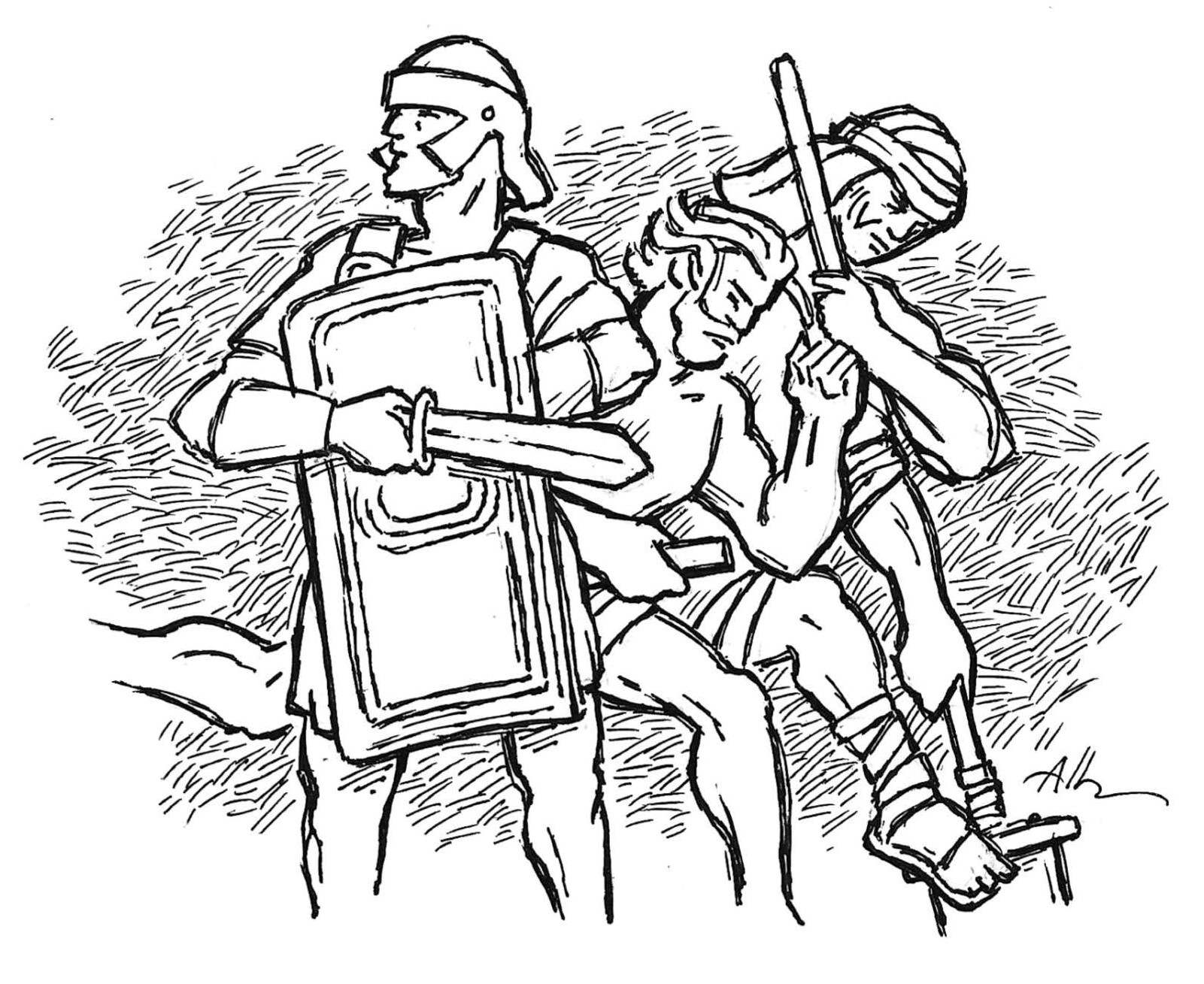
So; in our passage this morning—in 2 Timothy 2:3-7—the apostle Paul gives us three ready-made, well-known, easily understood examples of that kind of endurance in order to spur us on. In these five verses, we learn that we need to follow the examples of a soldier, a runner, and a farmer in developing our endurance for the gospel.
* * * * * * * * * *
So then; let’s get right into the things that this passage tells us. And the first thing we should notice in it is …
1. THE CALL TO ENDURE.
In verse 3, the apostle Paul wrote to Timothy and told him, “You therefore must endure hardship as a good soldier of Jesus Christ.”
Now; that’s the way that the translators of the New King James Version have put it. But the word that Paul used isn’t the ordinary word for ‘endurance’. The translation I’m using follows the old tradition of the King James Bible; however, a better way to translate what Paul wrote—based on better textual evidence—is as it’s found in the English Standard Version, where we’re told that Paul told Timothy, “Share in suffering …” The idea is that of ‘suffering along with’ someone else. The New American Standard version has Paul telling Timothy, “Suffer hardship with me …”; and personally, I believe that captures the idea the best. Although the word “endurance” isn’t actually used, it nevertheless captures the idea.
Paul was enduring for the faith. And for Timothy to ‘suffer hardship’ with him for the faith would be to share in Paul’s endurance. Look at what the apostle Paul told Timothy in 2 Timothy 1:8;
Therefore do not be ashamed of the testimony of our Lord, nor of me His prisoner, but share with me in the sufferings for the gospel according to the power of God … (2 Timothy 1:8).
Paul knew that Timothy was watching all that he had been suffering for the cause of the gospel—even to the point of being locked in a prison cell and awaiting execution. Yet, Paul also knew that Timothy was aware of the glorious outcome that he expected from it all—how he would be rewarded by the Lord Jesus for his faithful service and sacrifice. And so, Paul actually invited Timothy to “share with” him in his sufferings for the gospel; which would imply that he also shared in the hope.
And to help Timothy understand the kind of endurance for the faith that Paul was calling him to, he reminded him that he was to do so “as a good soldier of Jesus Christ”. It’s very important to notice that Paul wasn’t telling Timothy that he ought to endure so that he could become a good soldier of Jesus. Rather, Paul was reminding Timothy that he had already been enlisted as a soldier of Jesus—had already been behaving like a good one—and that he ought to keep on enduring like what he was.
You know, dear brothers and sisters in Christ; we may read those words and think that they’re perfectly suited for a pastor. And of course, they are. After all, they were written to encourage a pastor. But you and I both need to remember that we all—as believers—are also soldiers in the cause of the Lord; and that whatever our particular calling in our Lord’s service might be, we must endure like what we are in it. In 2 Corinthians 10:3-5, the apostle Paul wrote about this to the Corinthian believers. He didn’t write to pastors and ministry professionals; but rather, to those who, like all of us in Christ, have already been declared to be the Lord’s set-apart followers in this world—Jesus’ ‘enlisted’ ones. Paul told them,
For though we walk in the flesh, we do not war according to the flesh. For the weapons of our warfare are not carnal but mighty in God for pulling down strongholds, casting down arguments and every high thing that exalts itself against the knowledge of God, bringing every thought into captivity to the obedience of Christ … (2 Corinthians 10:3-5).
So, you see; you and I are already enlisted in the Lord’s service. We are already on a battlefield. We are already His soldiers—marching forward, declaring the truth of the gospel, resisting all the opposition of the devil and pulling down his lies, rescuing lost people from out of the devil’s captivity, and calling them to glorious freedom and liberty through faith in Christ.
We don’t war against people, of course. They’re not our enemy. But we do engage in battle! As Paul put it in Ephesians 6:10-13;
Finally, my brethren, be strong in the Lord and in the power of His might. Put on the whole armor of God, that you may be able to stand against the wiles of the devil. For we do not wrestle against flesh and blood, but against principalities, against powers, against the rulers of the darkness of this age, against spiritual hosts of wickedness in the heavenly places. Therefore take up the whole armor of God, that you may be able to withstand in the evil day, and having done all, to stand (Ephesians 6:10-13).
It’s not a question, then, of whether or not we’re soldiers in Christ’s cause. We already are His soldiers. We’re already on the battlefield. The question is whether or not we will be ‘good’ soldiers: soldiers who faithfully endure suffering for our Lord—keeping our eyes on the glorious outcome at the battle’s end.
* * * * * * * * * *
So; that’s how Paul began his words to Timothy in this passage—that is, with the call to ‘endure’. But how do we do that? How do we ‘endure’ in the faith in the way we should—looking ahead to the long-term benefits and blessings in spite of the short-term pain or pressure?
To help Timothy know what this would mean—and by extension, to help us also know—the apostle Paul gave …
2. THREE EXAMPLES THAT INSTRUCT.
These are three, plain, simple illustrations of everyday endurance that almost everyone in the world—living at any time in history—could recognize and easily understand. In each one of them, you can see that they show us what it means to remain faithful to a difficult task or responsibility without quitting—looking ahead to the long-term benefits and blessings despite the short-term pain or pressure.
The first example that Paul gives is found in verse 4—probably borrowing right away from what he told Timothy in verse 3. He wrote, “No one engaged in warfare entangles himself with the affairs of this life, that he may please him who enlisted him as a soldier.” This means that, as Jesus’ followers in this world, we need to exhibit the ready devotion of a soldier in our endurance.
Over the past couple of days, I’ve been having an interesting conversation with some of the church family members who have served in the military. I have been asking them something that—having never served in the military myself—I’ve always wondered. When a soldier is enlisted in the military, is there a requirement made known to them that—throughout the time of their enlistment—they would be expected to do nothing else but what was required of them in their service? In other words, are they to be dedicated to their military service exclusively … and to nothing else? I was surprised to learn that that isn’t necessarily the case. During a period of active military deployment, then yes—that would require the total commitment of their time and energy. But other than that, they are usually free to pursue an education, or conduct certain limited matters of business, or give necessary attention to their family’s needs.
And so, with that in mind, I thought that it was very interesting that the apostle Paul used the word that he used to describe the commitment of a soldier in this passage. A man or woman who is enlisted in military service must be careful not to be ‘entangled’ in the affairs of this life. During the time of their enlistment, they agree not to allow themselves to become so deeply enmeshed in matters of education, or business, or even family life—as they might in civilian life—that they cannot rise up immediately at the call of their commanding officials and perform their duty at a moment’s notice. Their enlistment requires that they keep continually on call—continually at the ready—so that they can serve at the pleasure of the president and their government at any time they are needed.
And it impresses me that that’s how our endurance is to look with respect to our service to the Lord Jesus. We all have duties to perform—to care for our families, to provide for our livelihoods, to perform faithfully at our vocations, to enjoy the legitimate pleasures of leisure. But we are, in a very real sense, to keep ourselves from becoming overly enmeshed in these affairs of life; and to be continually on call—continually at the ready—so that we can serve at His command whenever and however He wishes. And we’re to always do so with the ultimate expectation that we will be pleasing to Him; and that we will hear Him one day say to us, “Well done, good and faithful servant!”
There were some interesting incidents in our Lord’s earthly ministry that illustrate this. Luke 9:57-62 tells us;
Now it happened as they journeyed on the road, that someone said to Him, “Lord, I will follow You wherever You go.” And Jesus said to him, “Foxes have holes and birds of the air have nests, but the Son of Man has nowhere to lay His head.” Then He said to another, “Follow Me.” But he said, “Lord, let me first go and bury my father.” Jesus said to him, “Let the dead bury their own dead, but you go and preach the kingdom of God.” And another also said, “Lord, I will follow You, but let me first go and bid them farewell who are at my house.” But Jesus said to him, “No one, having put his hand to the plow, and looking back, is fit for the kingdom of God” (Luke 9:57-62).
I’ll never forget one of my old youth pastors. His nickname was ‘Doc’. He served as a medic in the army; and he was the most devoted servant of the Lord I’d ever known. We had a youth meeting one evening at someone’s home. During the meeting, he had to stop to take a phone call; and then, after he hung up, he looked at us all, smiled, and said, “Well, you guys, I fly out tomorrow morning.” He had just received a call from a friend with a mission organization about a short-term mission trip. The Lord needed him in a foreign country. He worked for his father; but now had to call him and let him know he’d be away for a while. We were all a bit shocked. But Doc looked at us all and said, “Listen; if you’re going to follow the Lord Jesus as you should, then you’ve got to be ready to jump up and go whenever He calls you.”
Now; I don’t believe our good Lord and Master will ever call us away from true responsibilities and needful duties of this life that are in accord with His will for us. But not all of the things of this life that we love to do are truly needful; and we’ve got to keep such a loose hold on the things of this world that we can immediately drop them and serve at His call—so that we can be available to Him whenever He calls us, and end up pleasing to Him. That’s what it means to endure with the ready devotion of a soldier.
Another example that Paul gave to Timothy is found in verse 5. Paul said, “And also if anyone competes in athletics, he is not crowned unless he competes according to the rules.” This means that, as Jesus’ followers, we must exhibit the disciplined perseverance of a world-class athlete in our endurance for Him.
Perhaps you know the story of the famous Native American athlete Jim Thorpe. He is considered by many—even today—to be the greatest athlete in American history. He was amazingly proficient in track and field, baseball, football, and even ballroom dancing. He was truly an all-round champion. In the 1912 Olympics in Stockholm, he won two gold medals for the Pentathlon and the Decathlon. But within just a few months of winning them, he was declared disqualified and had to return the medals. It was discovered that he had played semi-professional baseball one summer for only $5 a week; and at that time, no professional could compete in the Olympics. He was innocent in the matter, as he didn’t know that his brief stint in the semi-pros rendered him unqualified to compete. And it spoke highly of his character that he returned the medals—perhaps more highly than his reputation as an athlete could have done. But it also illustrates the principle that Paul was describing—that unless an athlete competes according to the rules, they are disqualified from the prize.
An athlete in the ancient Greek games—just as any athlete would do today—would give his or her all to preparing for the competition. They would strain every fiber of their being to win the race. They would truly ‘endure’. But that endurance had to also involve keeping the rules of the game. Otherwise, all of their ‘endurance’ physically would be for nothing. And the same is true for us in the service of the Lord. The apostle Paul put it this way in 1 Corinthians 9:24-27;
Do you not know that those who run in a race all run, but one receives the prize? Run in such a way that you may obtain it. And everyone who competes for the prize is temperate in all things. Now they do it to obtain a perishable crown, but we for an imperishable crown. Therefore I run thus: not with uncertainty. Thus I fight: not as one who beats the air. But I discipline my body and bring it into subjection, lest, when I have preached to others, I myself should become disqualified (1 Corinthians 9:24-27).
So, dear brothers and sisters; in our service to the cause of Christ, let’s be careful not only to endure with strength, but also to endure with integrity. Let’s persevere with the kind of self-discipline that doesn’t cut moral corners, or that doesn’t take moral short-cuts, or that doesn’t in any way bend the rules or cheat or engage in any kind of dishonesty—even if we think it’s somehow to the advancement of the Lord’s work to do so. Let’s endure in our service for the Lord with the disciplined perseverance of a world-class athlete.
And finally, notice one more example that Paul gives in verse 6. Paul wrote, “The hardworking farmer must be first to partake of the crops.” This teaches us that as Jesus’ faithful followers, we must exhibit the patient diligence of a farmer in our endurance for His cause.
I know only the tiniest bit about farming—mostly just from what I’ve watched other farmers do. And I can tell that I don’t have the physical build or the stamina for that kind of work. It’s amazingly hard and laborious. I’ve noticed that it involves long hours—with lots of very early mornings and lots of very late nights. And it’s all without much of a break along the way. That certainly reflects what the apostle Paul says in this verse; because he speaks of the farmer as being ‘hardworking’. The word he uses basically means to be made weary in the work. And another thing I’ve noticed is that I wouldn’t have the kind of patience it takes to be a farmer. The fruits of all that hard work don’t show themselves for a long, long time. But a good farmer does all of that hard, skillful, well-planned work with the confident expectation that the field will eventually grow produce … all in God’s perfect time.
Pastor James wrote about this as an illustration of endurance in the Christian life. He wrote about how we, as Jesus’ followers, will suffer persecution along the way for our faithful devotion to the cause of the gospel. But he said in James 5:7-8;
Therefore be patient, brethren, until the coming of the Lord. See how the farmer waits for the precious fruit of the earth, waiting patiently for it until it receives the early and latter rain. You also be patient. Establish your hearts, for the coming of the Lord is at hand (James 5:7-8).
What do you suppose the ‘crops’ are that we’re to expect to be partakers of? Is it the blessings we experience in life of good service? Is it the reward of praise and thanks? It may be. But I think a greater clue is found in what the apostle Paul wrote in 1 Thessalonians 2:19-20. He had been able to be with the Thessalonian believers for only a short time. But during that time, he worked very hard to establish them in the faith in the Lord Jesus; and he said,
For what is our hope, or joy, or crown of rejoicing? Is it not even you in the presence of our Lord Jesus Christ at His coming? For you are our glory and joy (1 Thessalonians 2:19-20).
During our time on this earth, we may not fully get to see the fruits of our labors for the gospel in the lives of others. But we will get to see them in due time—at the return of our Lord. And the delight we will have in seeing those we ministered to in the presence of the Lord Jesus—eternally blessed before Him and glorified forever in Him—will truly be our greatest joy. So; that’s how we ought to serve our Lord—with the patient diligence of a hardworking farmer who looks ahead in the distance—confidently—to the fruit of his labors.
* * * * * * * * * *
So; here’s Paul’s urgent call to Timothy: “You therefore must endure hardship as a good soldier of Jesus Christ.” And here are the examples he set before Timothy to teach him what that would mean: a soldier who is readily devoted, a runner who is disciplined in perseverance, and a farmer who is patient in labor.
And notice finally what Paul gave Timothy in verse 7;
3. THE APPEAL TO ‘CONSIDER’.
He told him, “Consider what I say, and may the Lord give you understanding in all things.” These examples of endurance—and the lessons that they have to teach—aren’t the kinds of things from which we can create a ‘one-size-fits-all’ set of rules to follow. What they might have meant in Timothy’s ministry could be quite different from the ministry of another pastor … or from the ministry of you and me.
What Paul urged Timothy to do is to let these examples roll around in his thinking for a while—to meditate on them and to consider them carefully. And Paul knew that the Lord Jesus Himself—the true Master for whom we work—would show Timothy just exactly how to put their various lessons to work in his own endurance for the Lord.
I believe the same is true for you and me. We need endurance in our service to the Lord Jesus. We need to be devoted in just the right way to please our Lord, and disciplined in just the right manner in His service to us, and patient for just the right outcome and fruit for our labors. He knows what this means in our particular situation; and He is able to teach us.
Let’s you and I do our part, then—and consider.
________________________________________
1Hupomonā; translated “perseverance” in the New King James Version in 2 Timothy 3:10; but also translated “endurance” in Hebrews 10:36.
AE