
Wednesday AM Bible Study; September 10, 2025 – Genesis 5:1-32
Theme: The story from Adam to Noah is a sad story of the spread of death in humanity because of sin; but a story that’s crowned with the joyful promise of redemption.
(All Scripture is taken from The New King James Version, unless otherwise indicated).
Click HERE for the audio version of this Bible Study.
Click HERE for the livestream archive of this Bible Study.
1 We have been considering what the Book of Genesis tells us about the fall of man in Chapter 3, and its impact on humanity in Chapter 4. And now, come to Chapter 5 and the story that seems to stretch out in two great, seemingly divergent extremes.
The first extreme is death. God had warned Adam in Genesis 2:16-17,
“Of every tree of the garden you may freely eat; but of the tree of the knowledge of good and evil you shall not eat; for in the day that you eat of it you shall surely die” (Genesis 2:16-17).
Our first parents ate in disobedience to God; and as we have seen, death did indeed occur—first in terms of their separation from God, then of their separation from each other, and finally of their separation from creation. Eventually, physical death would come—though not immediately. Fallen humanity became subject to mortality. It was as Romans 5:12 described it, “… just as through one man sin entered the world, and death through sin, and thus death spread to all men, because all sinned …” Human beings—made in the image of God—began to die.
But God did not allow humanity itself to die off. In Genesis 5, we see not only the spread of death making its progress throughout humankind, but also—along with humanity’s preservation—we see the progress of God’s gracious promise of a Redeemer (Genesis 3:15).
It shows us how God worked in mankind’s fall to bring about mankind’s redemption.
* * * * * * * * * *
Now; this chapter is largely the record of a genealogy. It’s the second genealogy we find in the Bible. The first one is the genealogical record of the family of Adam’s first son Cain, as it’s given to us in Genesis 2:16-22. But this one is the genealogical record of the family of Adam’s third son Seth. Cain—the murderer of his brother Abel—became the head of a lineage that was separate from the promise of ‘the Seed of the Woman’ described in Genesis 3:15. Seth became the head of the lineage from whom that promised Seed—the Redeemer of mankind—would be born. At the end of the genealogy of our Lord that is recorded in Luke 3, we find that it all began with “Seth, the son of Adam, the son of God” (Luke 3:38).
It may be tempting at times to pass by the genealogies of the Bible. But we should always treat them as a crucial part of the Word of God. They show us how the Bible is rooted in real history—with real people who had real lives and real names, and who lived in real places. They show us how God accomplished His sovereign plan through something that no one can possibly have human control over—who is born of whom.
Notice that this chapter begins by showing us …
1. THE TRAGIC PATTERN OF DEATH (vv. 1-25).
It begins with these words:
This is the book of the genealogy of Adam (Genesis 5:1a).
This marks out an important division in the Book of Genesis. Genesis is largely structured around the significant genealogies that it records. In Genesis 2:4, we’re told, “This is the history of the heavens and the earth when they were created, in the day that the Lord God made the earth and the heavens …”; and it then proceeds to tell us the story of humanity from the creation of Adam and Eve, to their temptation in the garden and their fall, and finally to the murder that their first son Cain committed against their second son Abel. The main focus of that section of the book was on how the fall led to the ungodly lineage of Cain on the earth—a lineage that ended with Lamech—the seventh from Adam through Cain. But now, a new division of the book begins—one which tells us the story of the godly lineage through Seth.
Notice that this chapter begins by repeating the story of God’s creation of the first man. The fact that it repeats that story shows us that the whole of the story of the Bible flows from something that is to be accepted by us as true history. Verses 1-5 go on to tell us;
In the day that God created man, He made him in the likeness of God. He created them male and female, and blessed them and called them Mankind in the day they were created. And Adam lived one hundred and thirty years, and begot a son in his own likeness, after his image, and named him Seth. After he begot Seth, the days of Adam were eight hundred years; and he had sons and daughters. So all the days that Adam lived were nine hundred and thirty years; and he died (vv. 1b-5).
Life in the pre-flood world was dramatically different from life as we know it today. One way it differed was that ‘life’ itself was lived much longer. Possibly because of the early purity of the human genetic system—or possibly because of the canopy of water over the earth that blocked out much of the harmful rays of the sun—or perhaps simply because God Himself willed that it be so—human beings lived extremely long lives of strength and vitality. Nevertheless, even those born into the godly lineage of Seth eventually died. As Genesis 6-27 goes on to tell us,
Seth lived one hundred and five years, and begot Enosh. After he begot Enosh, Seth lived eight hundred and seven years, and had sons and daughters. So all the days of Seth were nine hundred and twelve years; and he died.
Enosh lived ninety years, and begot Cainan. After he begot Cainan, Enosh lived eight hundred and fifteen years, and had sons and daughters. So all the days of Enosh were nine hundred and five years; and he died.
Cainan lived seventy years, and begot Mahalalel. After he begot Mahalalel, Cainan lived eight hundred and forty years, and had sons and daughters. So all the days of Cainan were nine hundred and ten years; and he died.
Mahalalel lived sixty-five years, and begot Jared. After he begot Jared, Mahalalel lived eight hundred and thirty years, and had sons and daughters. So all the days of Mahalalel were eight hundred and ninety-five years; and he died.
Jared lived one hundred and sixty-two years, and begot Enoch. After he begot Enoch, Jared lived eight hundred years, and had sons and daughters. So all the days of Jared were nine hundred and sixty-two years; and he died.
Enoch lived sixty-five years, and begot Methuselah. After he begot Methuselah, Enoch walked with God three hundred years, and had sons and daughters. So all the days of Enoch were three hundred and sixty-five years. And Enoch walked with God; and he was not, for God took him.
Methuselah lived one hundred and eighty-seven years, and begot Lamech. After he begot Lamech, Methuselah lived seven hundred and eighty-two years, and had sons and daughters. So all the days of Methuselah were nine hundred and sixty-nine years; and he died (vv. 6-27).
Adam lived to be 930, Seth 912, Enosh 905, Cainan 910, Mahalalel 895, Jared 962, Enoch 365, Methuselah 969, Lamech 777. This was great longevity from our perspective. But not from theirs. The fact that men died at all was a constant reminder of man’s fallenness. Note the sad repetition that we find after each man’s story—tolling like a monotonous and mournful bell—“and he died … and he died … and he died …” (vv. 5, 8, 11, 14, 17, 20, 27, 31).
But not all died. There was one remarkable exception. We’re told that the man Enoch—the seventh from Adam through Seth—did not die. He was history’s first prophet; because we find, in Jude 14-15, that Jude spoke a prophetic word of God against those who would deny the good news of the promised Seed of the woman:
Now Enoch, the seventh from Adam, prophesied about these men also, saying, “Behold, the Lord comes with ten thousands of His saints, to execute judgment on all, to convict all who are ungodly among them of all their ungodly deeds which they have committed in an ungodly way, and of all the harsh things which ungodly sinners have spoken against Him” (Jude 14-15).
We’re told that after Enoch begot his son Methuselah, he began to walk with God—perhaps in the sense of living a life of fellowship with Him in a way that he hadn’t before. And at a certain point—in his 365th year—“he was not, for God took him” (v. 24). Hebrews 11:5 gives us this explanation:
By faith Enoch was taken away so that he did not see death, “and was not found, because God had taken him”; for before he was taken he had this testimony, that he pleased God (Hebrews 11:5).
We certainly wish we could know more about this. But at the very least, this teaches us that even though physical death prevailed in humanity through the fall of Adam, God is a gracious God who promises victory over death by faith in the promised Seed of the woman—who, by the way, was born from the same lineage as that of Enoch (see Luke 3:37).
What a contrast there is between the lineage of Cain and the lineage of Seth! Yet, consider an interesting similarity. Do you notice that they both contain men named Enoch and Lamech? Enoch was the name of Cain’s first son (4:17). And Lamech was the name of the seventh from Cain—a man who murdered a young man for injuring him. But the man named Enoch, from the lineage of Seth, was the man who walked with God and did not die. And the man named Lamech, from the lineage of Seth, was another prophet who proclaimed progress in the keeping of God’s promise of redemption. He declared that through his son Noah, God would bring comfort to the world.
This leads us to notice that, though death reigned in humanity, God provided …
2. THE JOYFUL PRESERVATION OF PROMISE (vv. 28-29).
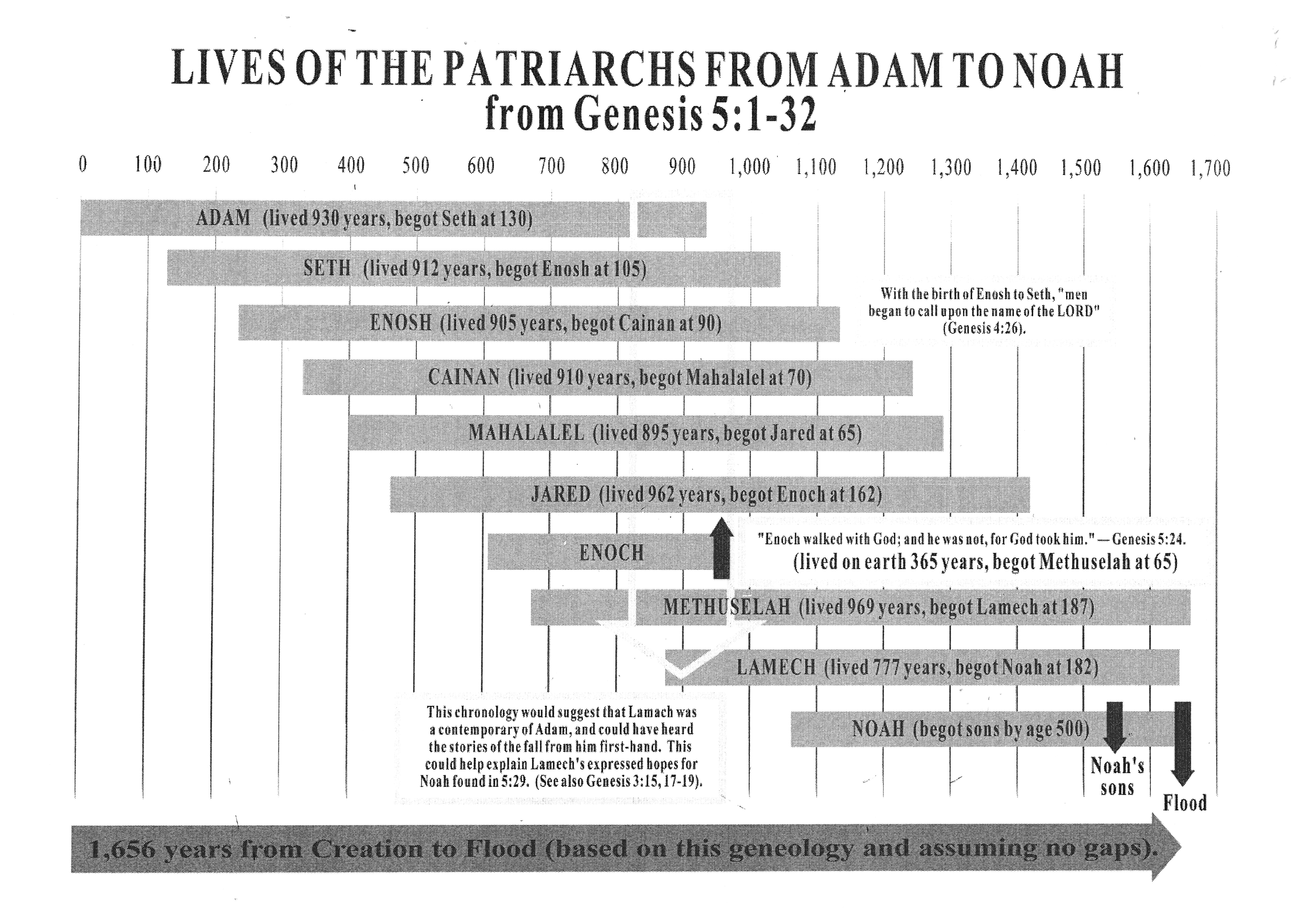
Though men died, they nevertheless begot sons ‘in their own likeness’ (v. 3). Adam begot Seth at age 130, Seth begot Enosh at age 105, Enosh begot Cainan at age 90, Cainan begot Mahalalel at age 70, Mahalalel begot Jared at age 65, Jared begot Enoch at age 162, Enoch begot Methuselah at age 65, Methuselah begot Lamech at age 187, Lamech begot Noah at age 182, and by the time Noah was 500 he had begotten Shem, Ham and Japheth. And it would be through the offspring of Noah’s son Shem that the promised Seed of the woman would be born (see Luke 3:36).
There are two things to notice from this. First, notice the grace of God. Even though the human race was cursed because of sin—and as a result, men died—God’s promise of the Seed of the woman was nevertheless not lost. And second, note that throughout all of this time, God had graciously preserved a reliable witness to the promise of that Seed.
If we arrange the lifespans of the generations after Adam through Seth in relation to one another in the flow of time, we make the fascinating discovery that Adam (the father of Seth) was a contemporary of Lamech (the father of Noah). It would have been possible for Lamech to have heard the stories of the fall—and of God’s promise concerning the Seed of the woman—firsthand from Adam (see the attached chart, ‘Lives of The Patriarchs from Adam to Noah’). This may explain why Lamech could express the hopes he had for Noah that we find in Genesis 5:28-29);
Lamech lived one hundred and eighty-two years, and had a son. And he called his name Noah,saying, “This one will comfort us concerning our work and the toil of our hands, because of the ground which the Lord has cursed” (Genesis 5:28-29).
Noah’s name meant ‘Rest’; and it was through the preservation of Noah and his family through the flood that God brought an end to the lineage of Cain on the earth, and preserved the lineage through whom the Seed of the woman would be born. We’re told in verses 30-32,
After he begot Noah, Lamech lived five hundred and ninety-five years, and had sons and daughters. So all the days of Lamech were seven hundred and seventy-seven years; and he died.
And Noah was five hundred years old, and Noah begot Shem, Ham, and Japheth (vv. 29-32).
* * * * * * * * * *
There were, no doubt, many other children born than the ones that are specifically mentioned in this genealogy. But this specific list of names gives us the whole, complete pre-flood lineage—without gaps—that led to the birth of our Redeemer. And Lamech—near the end of that genealogy—prophetically expressed the promise from God that God would provide the hope of comfort through his son Noah—and ultimately, through Shem, to our Savior.
Praise God that He kept His promise! The Seed of the woman has been born into this world. The serpent bruised His heel; but He will soon crush the serpent’s head!
________________________________________
1Much of the material for this study was adapted from the Bethany Bible Church study, Genesis & A Biblical Worldview (2012), Lesson 13.
AE