
Bethany Bible Church Sunday Sermon Message
September 7, 2025
2 Timothy 1:15-18
Theme: Faithfulness to the cause of the Lord Jesus often means refreshing the faithfulness of others.
(All Scripture is taken from The New King James Version, unless otherwise indicated).
Click HERE for the audio version of this sermon.
Many years ago, our church was going through a very difficult trial. And I was going through a very difficult time of testing along with it.
It involved the sad but necessary task of church discipline. And as the pastor, much of the weight of this particular matter fell upon me. During that time, my precious wife and I spent many sleepless evenings staring at the ceiling—talking, weeping, and praying. There were a lot of questions, a few harsh confrontations, and even a little bit of division within the church family over it all. Though it was many years ago, I still consider it one of the most difficult periods of my ministry as a pastor. And apparently, during that time, some people in the church family could see how it was taking a toll on me personally.
But there was something in it all that I’ll never forget. One particular member of the church family could see how burdened I felt by it all, and came to me and said, “So; what are you doing on Tuesday morning?—say around 6:30?” And he and I met during that time—for an hour or so—just before he went off to work. It didn’t happen just once or twice; but for a couple of months. We met at the church every Tuesday to have coffee, explore the Bible, and pray together about this whole matter. He came specifically to meet with me, to bear this terrible burden with me, to assure me that I was on the right track, to let me know that I wasn’t alone, and that I was going to be alright.
I can’t tell you enough how much that meant to me. He truly ministered to me by bringing refreshment to my soul.
* * * * * * * * * *
Now; the difficult trial that I went through—as terrible as it seemed at the time—was nothing compared to what the apostle Paul was going through when he wrote his second letter to Pastor Timothy. He was confined to a prison cell in Rome. It was cold, and dark, and smelly, and very gloomy. He had no cloak to keep him warm, no books to read, and no one to keep him company. He was shackled with a chain and was kept under guard. And at the time he wrote this letter, he was even expecting very shortly to be put to death by order of Emperor Nero for his steadfast commitment to the message of the gospel.
What’s more, all those whom he had hoped would come and support him and would stand with him in his defense in the trial had abandoned him. They were afraid of being associated with him. At the end of this letter, he let Timothy know that almost every one of his closest coworkers had forsaken him. He wrote to Timothy, asking him to come soon to be with him. He asked him to be sure to bring his cloak so that he could keep warm, and to bring some books and parchments so he could read and write. It must have been an almost unbearable time of sorrow and hardship and loneliness for this great apostle—a man whose only passion was to proclaim the good news of God’s love to people, and to invite them to be saved through faith in Jesus Christ.
But that brings us to a high point in his letter to Timothy. There was one man—a man named Onesiphorus—who had gone out of his way to minister comfort and support to Paul during this dark time. Paul wrote about it in 2 Timothy 1:15-18. He told Pastor Timothy,
This you know, that all those in Asia have turned away from me, among whom are Phygellus and Hermogenes. The Lord grant mercy to the household of Onesiphorus, for he often refreshed me, and was not ashamed of my chain; but when he arrived in Rome, he sought me out very zealously and found me. The Lord grant to him that he may find mercy from the Lord in that Day—and you know very well how many ways he ministered to me at Ephesus (2 Timothy 1:15-18).
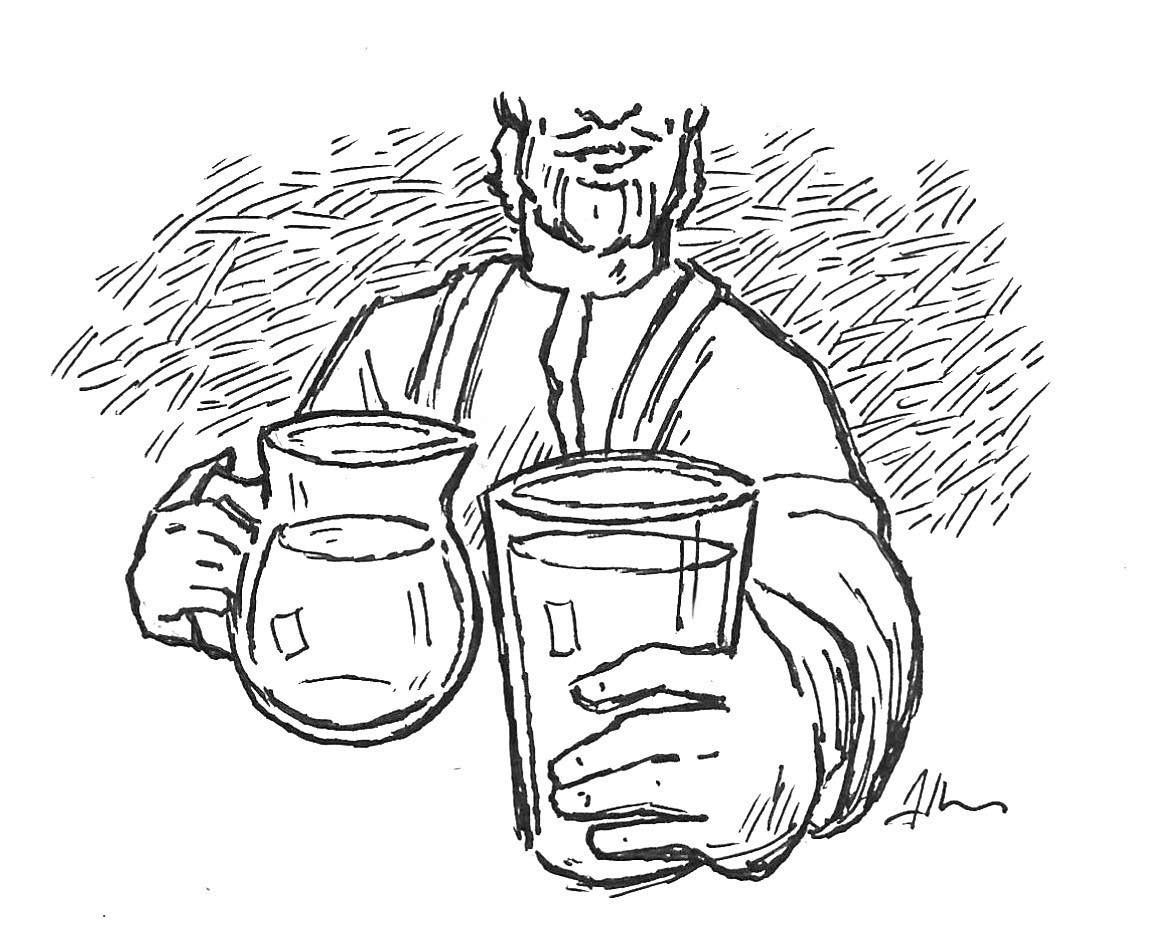
What stands out in those four verses is the word “refreshed”. Onesiphorus came and often ‘refreshed’ Paul. It’s a word that, in the original language, meant ‘to cool again’—as if to open up the window and bring in some fresh air, or to give a cup of cool water in order to bring relief from the heat of the day. And that’s what Onesiphorus gave to Paul. Relief. Refreshing. Onesiphorus wasn’t able to get Paul out of prison, of course. And he wasn’t able to deliver Paul from execution. But his encouraging presence nevertheless brought welcomed relief to Paul in his burden. It felt to him like a cup of cool water and a breath of fresh air. It uplifted and strengthened him in his time of trial for the cause of the gospel. It helped him in his efforts to keep faithful to the Lord’s call on his life.
And this has made me think, dear brothers and sisters, about how much we need this from one another. It may be that—at times—we become misunderstood in our zeal for the Lord. It may be that we are spoken against, or hated, or shunned in our stand for God’s call to righteousness. It may even be that we experience open acts of hostility and persecution because of our faithfulness to Jesus’ call. It can be a terrible trial to go through; and the pressure may seem unbearable and unrelenting. And yet, even though another brother or sister cannot necessarily take the pain of the trial away from us, they can most certainly bring refreshment to us through a kindly visit, or an understanding ear, or even a word of encouragement from the Bible that lets us know that we’re alright … that we’re doing the right thing in it all and that God has His hand on us. It often gives us just the boost that we need to keep on going.
This truly is a ministry that we should provide to one another in the church family—the ministry of refreshment. God Himself very often equips us for it and calls us to put it into practice toward one another. Think of what Paul wrote to the Corinthian believers in 2 Corinthians 1:3-7;
Blessed be the God and Father of our Lord Jesus Christ, the Father of mercies and God of all comfort, who comforts us in all our tribulation, that we may be able to comfort those who are in any trouble, with the comfort with which we ourselves are comforted by God. For as the sufferings of Christ abound in us, so our consolation also abounds through Christ. Now if we are afflicted, it is for your consolation and salvation, which is effective for enduring the same sufferings which we also suffer. Or if we are comforted, it is for your consolation and salvation. And our hope for you is steadfast, because we know that as you are partakers of the sufferings, so also you will partake of the consolation (2 Corinthians 1:3-7).
That’s just another way of describing the kind of ministry of refreshment that we find in 2 Timothy 1:15-18.
* * * * * * * * * *
Now; it would be very important to understand Paul’s words in the context of his letter to Timothy.
Pastor Timothy had been carefully watching how Paul had suffered for the cause of the gospel. He loved Paul, and was grateful for all that he had learned from him. He never forgot how Paul had led him to the Lord and had taught him in the faith. He always remembered how Paul had laid his hands on him and commissioned him to the ministry. But in seeing all that Paul was going through, it wouldn’t come as much of a surprise if Timothy became concerned, and maybe even became tempted to hold back his ministry. Many were demonstrating that they had become ashamed of Paul because of the things that he was going through. Timothy may have felt that temptation too—and most likely, so might we.
But Paul reminded Timothy that God had not given him a spirit of fear, but of power and of love and of a sound mind. In 2 Timothy 1:8, he told him,
Therefore do not be ashamed of the testimony of our Lord, nor of me His prisoner, but share with me in the sufferings for the gospel according to the power of God (2 Timothy 1:8).
He urged Timothy to faithfully keep hold of the pattern of sound words Paul had taught him, and to preserve, protect, and proclaim the precious gospel of Jesus Christ—just as it had been passed on to him. He urged him not to draw back, or to let fear and shame silence him in his ministry. That, of course, is a message we ourselves need to hear today.
Notice how we’re told, in this passage, that ….
1. SOME TURNED AWAY FROM PAUL IN HIS NEED.
He told Timothy in verse 15, “This you know, that all those in Asia have turned away from me, among whom are Phygellus and Hermogenes.”
Near the end of this letter, Paul mentioned the fact that he had to give a defense for himself in the imperial court. It may have been that he had been charged with a crime of sedition against the Roman state, since he was proclaiming that Jesus was the true Savior of mankind, and that all people were obligated to trust and worship Him—which meant that Nero wasn’t the ultimate authority. And it may have been that he had hoped that many of his fellow believers and coworkers from his ministry in Asia Minor would come and testify on his behalf—showing that he was not behaving in s seditious way against the Roman government at all, and that he was actually preaching about a King whose kingdom is not of this world. There would have been many professing believers, co-ministers, and pastoral leaders who could have come to Paul’s defense from the various cities of Asia. The city in which Timothy was serving as pastor—the city of Ephesus—was one of them. But no one came to his defense. In fact—as it’s said in the original language of verse 15—all those in Asia had been turned away from him. It may have been that—at one time—they would have stood with Paul; but the fear of the circumstances of his arrest and impending execution had caused them to deny any association with him.
Apparently, Timothy knew all this. In fact, the way Paul puts it in the original language is that he knew it very well. But it may nevertheless have come as a shock to Timothy to read that this was even true of Phygellus and Hermogenes. We don’t know anything about these two men except that they’re mentioned in this verse. It could be that they had been key leaders in the ministry, and had formerly been a great help to Paul in his preaching. But Paul seems to have mentioned them because no one would have expected that they—of all people—would have also been caught up in fear and turned away. What a sad thing it would be that the only mention made of you in the Bible was that you turned away from God’s preacher of the gospel out of fear!
I don’t believe that they necessarily were unbelievers. In fact, near the end of the letter, Paul spoke of such people. He very graciously said, “May it not be charged against them” (4:16). But I believe that Paul mentions those who had been turned away from him—and particularly the failure of Phygellus and Hermogenes—in order to make the next thing that Paul told Timothy stand out in stark contrast.
Others that Paul had trusted had turned away …
2. BUT HIS FRIEND ONESIPHORUS REFRESHED HIS SOUL …
In verse 16, he wrote, “The Lord grant mercy to the household of Onesiphorus, for he often refreshed me …” And that’s why he reminded Timothy of the bold, compassionate ‘refreshing’ ministry of Onesiphorus. Others had fallen by the wayside because of fear and shame; but not Onesiphorus. He even went out of his way to ‘refresh’ Paul in his time of suffering.
Onesiphorus’ story shows us that faithfulness to the cause of the Lord Jesus often means refreshing the faithfulness of others.
* * * * * * * * * *
Now; who exactly was this man Onesiphorus? His name meant ‘profit-bringer’; and he certainly proved true to his name in how he ministered comfort and encouragement to Paul. But all that we know of him is from the very brief mentions that Paul made of him in this letter.
It’s clear that he came from Ephesus—and from the church in which Timothy served—because Timothy is told in 4:19 to greet ‘the household of Onesiphorus’. And because Onesiphorus did some extensive traveling on Paul’s behalf, it may even be that he was a somewhat wealthy man—a man who had means and who had a noteworthy household that could be greeted.
But isn’t it interesting that Paul keeps asking Timothy to pass on his blessing to Onesiphorus’ household? Isn’t it interesting that Paul spoke of Onesiphorus’ ministry in the past tense?—reminding Timothy that he knew very well how Onesiphorus ‘ministered’? And isn’t it interesting that Paul expressed his wish that the Lord would show ‘mercy’ to Onesiphorus’ household—and also to Onesiphorus himself? This has led many Bible scholars to speculate that Onesiphorus was no longer living at the time that Paul wrote. After all, if Onesiphorus had left Rome and was on his way back to Ephesus, then he would have most likely arrived at around the same time as Paul’s letter; and it would have been unnecessary to ask Timothy to greet only his household. It may be that Onesiphorus’s willingness to minister to Paul in his time of need ended up costing him his own life. It may be that ended up suffering the very thing that everyone else was fearing would happen to them—that is, that he become arrested because of his association with the ‘criminal’ Paul, and was executed. We can’t be certain of this, of course. But if it’s true that he ministered refreshment to Paul at the cost of his own life, then it only underscores all the more how his own faithfulness in refreshing Paul was vital to the cause of Paul’s own faithfulness to the gospel.
We can learn a lot from this man, Onesiphorus. So; let’s look carefully at how Onesiphorus performed this ministry of refreshment to Paul. I suggest that we can see six things that stand out.
First, he ministered refreshment repeatedly. You can see this in verse 16. Paul wrote, “for he often refreshed me.” Apparently, when Onesiphorus came to Paul, it wasn’t just for one visit only. A ‘one-time-only’ visit wouldn’t have been sufficient to lift Paul’s spirits in the trial that he was under. Instead, Onesiphorus came over and over again—perhaps as often as the officials would permit.
This makes me think back to that good brother who came to visit me. He didn’t come just once, but repeatedly. That trial that I was under brought new challenges with almost every passing day. But my good brother came back to minister new refreshing to me in the light of each of those new challenges. That, I believe, is one of the important ways that such refreshing needs to be ministered: not just once, but repeatedly throughout the duration of the time of testing—and perhaps beyond.
Second, Onesiphorus ministered refreshment to Paul unashamedly. Others may have been embarrassed and ashamed of the things that Paul was suffering. It may have tempted them to become ashamed of the gospel that Paul preached. It may have even tempted them—if I may dare to say it—to become ashamed of the Lord Jesus Himself. There’s no question that in this fallen world, we must bear a measure of shame in the world’s eyes if we’re going to be faithful followers of Jesus. But with regard to Onesiphorus, Paul wrote in verse 16 that he “was not ashamed of my chain”. He was not hindered in his ministry of refreshment to Paul – either by Paul’s suffering, or by the false accusations made against Paul, or by Paul’s message, or by Paul’s Lord and Savior.
This serves as a great example to us whenever we’re called upon to provide refreshment to the soul of another brother or sister—especially when even other professing believers seem to be turning away from them. Letting that suffering brother or sister know that they’re not alone—and that, no matter what, we’ll be there with them—truly brings ‘a cool drink of water’ to their exhausted soul.
Third, Onesiphorus ministered refreshment to Paul strenuously. That’s the best word I can come up with for it. Onesiphorus really extended himself—at what seemed like tremendous effort and personal cost—to bring refreshment to Paul. We see this in verse 17, where Paul simply said, “but when he arrived in Rome …”
If Onesiphorus lived in Ephesus—as it certainly appears that he did—then he would have traveled a long distance to get to Paul. Rome was over 800 miles from Ephesus as the crow flies. But back in those days, no one traveled by crow. Traveling across land would have been the way to go; and this made this journey much longer—perhaps more like 1,200 miles. At 25 to 30 miles a day—at the very best—that would have made this a journey of somewhere between four to five weeks. And even if it was across the sea, it still would have taken several weeks—and with all the expenses that such a journey would have required. But none of this seemed to matter to Onesiphorus. When he heard that Paul was all alone and abandoned in his trial, he dropped everything and immediately set out on the journey.
And think of what an example this is to us, dear brothers and sisters. That friend of mine carved out time out of his day—each week—early in the morning—to make his way to me and to minister refreshment to my soul when I needed it. How much easier it is for us today to simply pick up a phone and make a call, or to hop in a car and make the drive, or even send a physical postcard in the mail. We truly encourage the soul of a suffering brother or sister when they see that we took the effort—or paid the price—to strenuously minister needed refreshment to them.
A fourth way that we see that Onesiphorus ministered refreshment to Paul is in that he did so diligently. As Paul said in verse 17, when he arrived in Rome, “he sought me out very zealously and found me.”
Rome was an enormous city. And it was also a city with a lot of prisons. When Onesiphorus arrived, he couldn’t just walk into the local police station, give Paul’s name, and have someone check the data bank to find his location. What’s more—under Nero’s rule—it was a city that was under a certain amount of unrest and disturbance. Prisoners were moved around a lot. And yet, Onesiphorus kept seeking Paul, and kept asking questions about his location, and kept searching around from prison location to prison location—probably keeping at it in spite of government resistance and indifference, and probably with a certain amount of risk to himself—until he at long last found him.
Can you just imagine what it must have been like for Paul when—as he sat lonely and alone in that prison cell—he suddenly looked up to see Onesiphorus happily walking in to see him? Can you imagine what it must have been like to hear Onesiphorus tell him how—after much searching and striving and praying—he finally found him? What a tremendous act of love! And think of what it means to another needy brother or sister in our day, when we keep diligently pursuing them and offering the needy ministry of refreshment to them—when we keep on making the calls and keep on seeking the opportunity to visit. Think of how that tells them that we truly love them.
A fifth way that Onesiphorus ministered refreshment to Paul was sacrificially. Again, this is based cautiously on the assumption that Onesiphorus was no longer living at the time that Paul wrote to Timothy. But look at what Paul said in verse 18: “The Lord grant to him that he may find mercy from the Lord in that Day …” It may be that Paul recognized that Onesiphorus’ efforts to minister merciful refreshment to him cost him dearly—perhaps ultimately. And at the very least, he recognized that he could have—in no human way—repaid Onesiphorus for what he did for him. All he could do was express the wish that the Lord Jesus would reward him wonderfully on the day of His return—at that day when He rewards all those who faithfully serve Him.
There may be times when we’re called upon to minister refreshment to another brother or sister in ways that cost us significantly. Clearly, there will be times when our association in love with another brother or sister who is suffering persecution for Jesus’ sake will also turn hostile attention in our direction. But didn’t Jesus Himself suffer the shame of this world in order to bear the guilt of our sins upon Himself and pay the price for us? It certainly isn’t much for us to bring refreshment to one another in times of need—even if we ourselves have to suffer along with them for it. The Lord Jesus Himself always sees it when we seek to minister encouragement to a brother or sister in need—and He will reward our loving service in His name.
And finally, another way that Onesiphorus brought refreshment to Paul was—for lack of a better way of putting it—characteristically. What I mean by that is that it was something people would have seen, and that would have made them think, “Isn’t that just like Onesiphorus?—the Lord’s true Profit-Bringer?” I think we can pick up on this from the end of verse 18. Paul—at the close of it all—told Timothy, “and you know very well how many ways he ministered to me at Ephesus.”
You should know that many competent Bible scholars do not consider the words “to me” in that verse a part of the original text of Paul’s letter. It may point this out in the footnote of the Bible translation you’re using. It’s possible that some copyist added the words “to me” later—hoping to emphasize the impact of Onesiphorus’ ministry to Paul. But the actual meaning is that Onesiphorus was known for having ministered in many ways in the church in Ephesus—not just to Paul, and not just to Timothy, but to everyone. In other words, the ‘refreshment’ that Onesiphorus brought to Paul so repeatedly, unashamedly, strenuously, diligently, and sacrificially was simply a way that he behaved characteristically. This was something that Timothy—as the pastor of the Ephesian church—knew better than anyone.
And this suggests to us, dear brothers and sisters in Christ, that we ought to develop a heart of sacrificial love and concern for one another that is so characteristic of who we are—under the loving Lordship of Jesus—that a ‘ministry of refreshment’ simply comes naturally. The ‘ministry of refreshment’ ought to be a normal, habitual outflow of the work of the Holy Spirit in us toward one another.
* * * * * * * * * *
Now; before we end our look at this passage—and at Onesiphorus’ remarkable ministry of refreshment to Paul—I ask that you notice something about this passage. The word ‘mercy’ shows up twice. In verse 16, in light of the sacrifice that he had made for him, Paul wrote, “The Lord grant mercy to the household of Onesiphorus …” This may be because it cost the household of Onesiphorus something significant for the head of their household to do this for Paul. And in verse 18, upon reflection of all that Onesiphorus had done for him, Paul wrote, “The Lord grant to him that he may find mercy from the Lord in that Day …” This may be because it had cost Onesiphorus something significant to do this for Paul.
In the end, the ministry of refreshment is nothing other than an expression of mercy in the name of the Lord Jesus. It is the Holy Spirit’s own fruit of ‘mercy’ produced in us. And the Lord Himself made a great promise about that. In the Sermon on the Mount, He said,
Blessed are the merciful,
For they shall obtain mercy (Matthew 5:7).
Shouldn’t that be a good incentive for you and me to learn more about showing ‘the ministry of refreshment’ to one another?
AE