
Bethany Bible Church Sunday Sermon Message
July 6, 2025
Psalms 88-89
Theme: We must be realistic about trials; but unless we see God’s lovingkindness and faithfulness in those trials, we’re not being realistic enough.
(All Scripture is taken from The New King James Version, unless otherwise indicated).
Click HERE for the audio version of this sermon.
Click HERE for the video archive of this sermon.
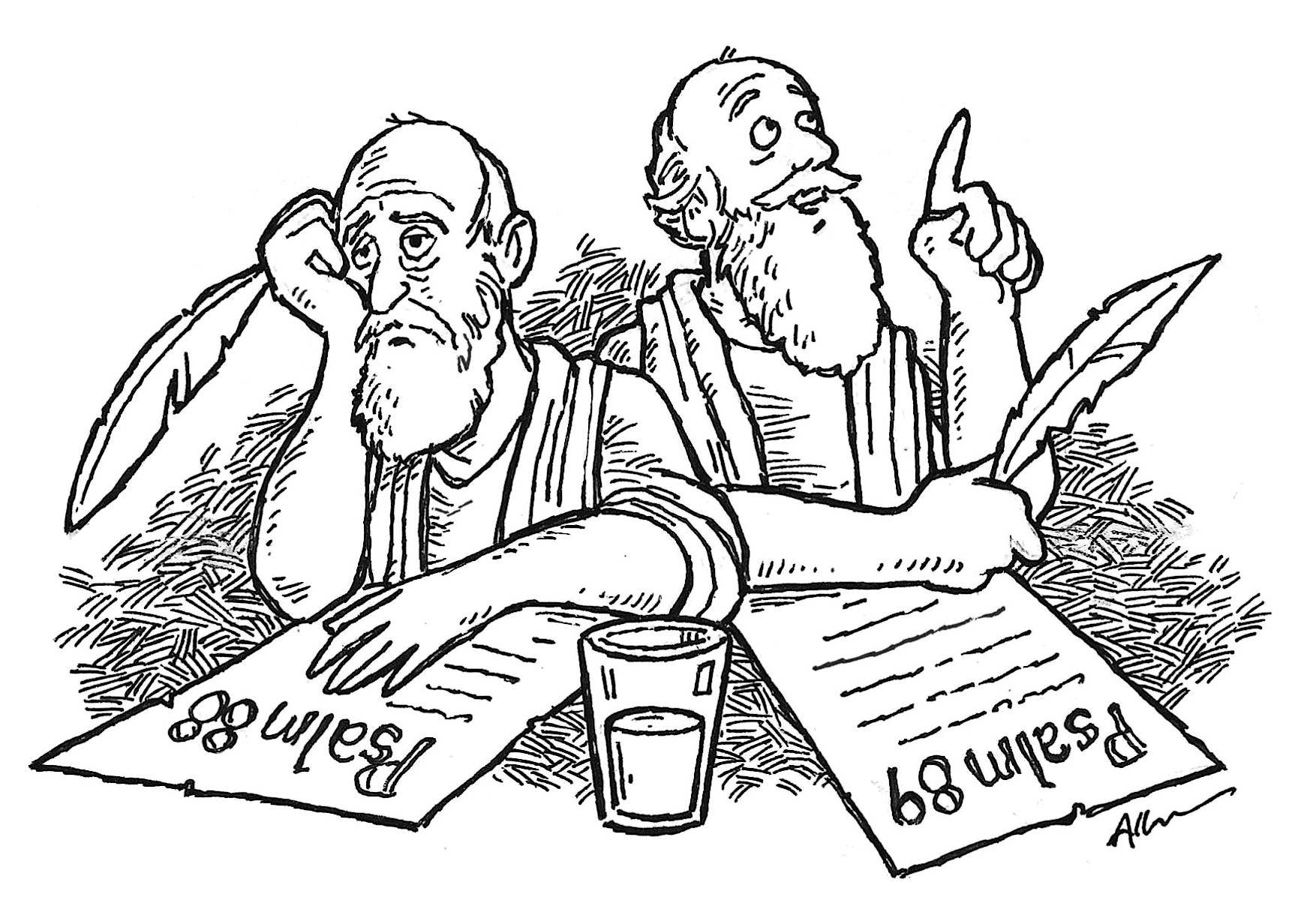
This morning, I’d like to ask that we spend some time in two different Psalms. They were written by two men whom you may not have heard of before. Psalm 88 was written by a man named Heman; and Psalm 89 was written by a man named Ethan. They are psalms that were written when both of these men were going through times of deep trial; and because both men cried out to God in their trials, they both have significant lessons to teach us.
But the reason I’d like for us to look at them together is because there’s an important spiritual principle for us to learn from the different perspectives that those two men expressed with respect to their trials. To put it simply, one man looked at his trial and cried out to God in it; and that, of course, is always a good and right thing to do. But the other man first intentionally looked at God in the midst of his trial; and that had a dramatic impact on the way in which He cried out to God in it.
* * * * * * * * * *
Now; these two Psalms have a lot in common. First of all, if you look at the introduction to these two psalms, you’ll find that they’re both what are called “contemplations”. The Hebrew word that’s used in the title of these two psalms is maskil; and that means ‘a contemplative poem’ or ‘a song intended to teach’. There are a total of thirteen such contemplative psalms in the Book of the Psalms, and Psalms 88 and 89 are the eleventh and twelfth of them. So; they were both written with the shared purpose of specifically teaching us something.
Another thing that they have in common is that they were written by two men who—as far as we know—wrote no other psalms than these two psalms. It’s a little difficult to say with any certainty who these two men were. But the evidence suggests that they were both godly and wise men who were a part of the royal leaders of worship and song that had been established during the reign of King David. It seems that they both served under the reign of King Solomon.1 So; the role of the authors of these two psalms is another thing that they have in common.
And a third thing that they have in common is that they both have ‘suffering’ as their themes. The writers of both of these psalms described how they were undergoing intense trials; and they both were realistic about the pain they were experiencing in their trials.
But the key difference between them is found in the way that they expressed their individual trials—and particularly, the way that their view of God had impacted their outlook. I believe that, in the providence of God, these two psalms were put in the Bible right next to each other for a reason. It’s so that we could read them together and learn from this difference. There’s a tremendous lesson for us to learn by comparing them. It’s that we must be realistic about trials; but unless we see God’s lovingkindness and faithfulness in those trials, we’re not being realistic enough.
* * * * * * * * * *
So; let’s begin by looking at Psalm 88—the psalm that was written by the man named Heman. In the Book of the Psalms, the introduction to a psalm is part of the inspired text from God; and we need to pay attention to it. Psalm 88 begins with these words:
A Song. A Psalm of the sons of Korah. To the Chief Musician. Set to “Mahalath Leannoth.” A Contemplation of Heman the Ezrahite.
The sons of Korah were a part of King David’s administration who traced their lineage back to the priestly tribe of Levi; and who served in an official capacity in worship and praise. This song has authority; because it was written under the authority of the sons of Korah for use by the Chief Musician of this order. It was set to a particular tune that was used in formal worship. It’s a very serious psalm that may have been sung or cited in particular times of sorrow.
Now; before I read Psalm 88 to you, I need to tell you about a way that I once misused it. I was with a friend once who was undergoing a very painful trial; and I wanted to give them encouragement. I remembered that one of my professors in Bible college spoke of how he had a friend who was undergoing a time of trial; and how he sat together with his friend and read randomly from the Psalms. It lifted his friend’s spirits. And so that’s what I sought to do with the person I was wanting to help. My Bible just happened to flop open to Psalm 88, and I began to read. It said;
O Lord, God of my salvation,
I have cried out day and night before You.
Let my prayer come before You;
Incline Your ear to my cry (Psalm 88:1-2).
“This is good,” I thought. “This seems like just what my friend needs.” So I read on:
For my soul is full of troubles,
And my life draws near to the grave.
I am counted with those who go down to the pit;
I am like a man who has no strength,
Adrift among the dead,
Like the slain who lie in the grave,
Whom You remember no more,
And who are cut off from Your hand.You have laid me in the lowest pit,
In darkness, in the depths.
Your wrath lies heavy upon me,
And You have afflicted me with all Your waves. Selah2
You have put away my acquaintances far from me;
You have made me an abomination to them;
I am shut up, and I cannot get out;
My eye wastes away because of affliction (vv. 3-9a).
At this point, I was beginning to wonder if I had opened up to the right psalm for the occasion. I kept reading, hoping that it would become more encouraging. It didn’t.
Lord, I have called daily upon You;
I have stretched out my hands to You.
Will You work wonders for the dead?
Shall the dead arise and praise You? SelahShall Your lovingkindness be declared in the grave?
Or Your faithfulness in the place of destruction?
Shall Your wonders be known in the dark?
And Your righteousness in the land of forgetfulness? (vv. 9b-12).
I could tell by the look in my friend’s eyes that this really wasn’t helping. I began to think that I should just stop. But I kept right on going … hoping for some positive resolution at the end.
But to You I have cried out, O Lord,
And in the morning my prayer comes before You.
Lord, why do You cast off my soul?
Why do You hide Your face from me?
I have been afflicted and ready to die from my youth;
I suffer Your terrors;
I am distraught.
Your fierce wrath has gone over me;
Your terrors have cut me off.
They came around me all day long like water;
They engulfed me altogether.
Loved one and friend You have put far from me,
And my acquaintances into darkness (vv. 13-18).
That hoped-for ‘resolution’ never came. And by the time I finished reading this psalm, it was very clear that I hadn’t given my friend the encouragement that I intended to give. In fact, it seemed that I had made the suffering worse. Since then, I’ve learned an important lesson. The psalms are a lot like medicine; you should only administer them to a friend in need thoughtfully and carefully … and never indiscriminately.
And that’s how I first encountered Psalm 88. It is—without a doubt—the darkest psalm in all the Book of the Psalms. And after I misused it so badly with my suffering Christian friend, I wondered why it was that God chose to include it in His Bible. But since then, I’ve grown to appreciate why. It’s a powerfully honest expression of the pain of suffering and trial; and some folks have said that it helps them see that God understands when we feel as if He is far away and not listening. We can be very glad that there’s a psalm like this in the Bible … but we can also be glad that it’s the only one like this.
Now; Heman did the right thing in this psalm. He set a good example for us in that he turned to God in his suffering—even when it seemed as if God was far away. In verse 1, he said “O LORD, God of my salvation, I have cried out day and night before you.” In his deep trial of suffering—and in his feeling of being abandoned by God, he didn’t give up. He kept on crying out to Him. In verse 9, he said, “Lord, I have called daily upon You; I have stretched out my hands to you.” He felt great sorrow and despair; and feared that he would fade away and go to the place of the dead in his suffering. He even felt as if God had cast him off completely. And yet, as verse 13 says, “But to You I have cried out, O LORD, and in the morning my prayer comes before You.” At a time when many would stop crying out to God, Heman didn’t. And in this, he has a great lesson to teach us.
And what’s more, I even wonder if this psalm isn’t giving us just the faintest hint of what the Lord Jesus felt when He hung on the cross for us. He cried out, “My God, My God, why have You forsaken Me?” Perhaps Heman was anticipating our Lord’s sacrifice for us with the words of verse 4; “I am counted with those who go down to the pit”; or in verse 7, “Your wrath lies heavy upon me”.
* * * * * * * * * *
But what stands out to me the most in Psalm 88 is that Heman saw things primarily from his own experience of suffering. He looked directly at his pain and anguish, and cried out to God in anguish as a result. We all tend to do that, don’t we? But that’s what has made the next psalm seem so different to me. In Psalm 89, the psalmist Ethan first took a good, long, hard look at God Himself. He began by celebrating and praising God’s character. In fact, he spent most of the psalm glorifying God—and even quoting God’s promises. And only then, after carefully celebrating the character of God, he talked about his trial. And that changed his whole perspective with respect to his suffering.
Let’s now look at Psalm 89. The introduction seems very much like that of Psalm 88. It says, “A Contemplation of Ethan the Ezrahite.” It too is a maskil; that is, a royally authorized psalm written for worship and intended for instruction. But look at how differently it begins:
I will sing of the mercies of the Lord forever;
With my mouth will I make known Your faithfulness to all generations (Psalm 89:1).
There are two qualities of God that Ethan mentions right at the very start. The first is the Lord’s “mercies”. That’s the wonderful Hebrew word chesed; which speaks of God’s steadfast and loyal love—a compassionate and merciful love that will never fail. It’s a word that shows up seven times in this psalm. And the other quality is God’s “faithfulness”. That speaks of God’s firm commitment and total trustworthiness to keep all of His promises. It, too, is a word that shows up seven times in this psalm.
These two qualities—God’s mercy and God’s faithfulness—are the main themes of the largest portion of this psalm. If you were to look back at Psalm 88:11, you’d see that Heman mentioned them too. However, Ethan goes on to explore those two qualities in depth. He repeated his emphasis on these two qualities in verse 2;
For I have said, “Mercy shall be built up forever;
Your faithfulness You shall establish in the very heavens” (v. 2).
Throughout this psalm—even before he gets around to talking about his deep trial of suffering—Ethan shines the spotlight repeatedly on these two things: God’s steadfast mercy, and His firm faithfulness. And as if to put those qualities on display, Ethan goes on to quote God Himself:
“I have made a covenant with My chosen,
I have sworn to My servant David:
‘Your seed I will establish forever,
And build up your throne to all generations.’” Selah
God’s “chosen” one was King David. And David’s “seed” is the royal offspring that was promised to be born from David—particularly the Messiah that would come from his royal lineage. In other words, Ethan was taking the themes of God’s mercy and faithfulness and applying them to the promise that God had given to David concerning the reign of Christ on this earth.
Ethan goes on to speak of what God is like in the light of this great promise;
And the heavens will praise Your wonders, O Lord;
Your faithfulness also in the assembly of the saints.
For who in the heavens can be compared to the Lord?
Who among the sons of the mighty can be likened to the Lord?
God is greatly to be feared in the assembly of the saints,
And to be held in reverence by all those around Him.
O Lord God of hosts,
Who is mighty like You, O Lord?
Your faithfulness also surrounds You.
You rule the raging of the sea;
When its waves rise, You still them.
You have broken Rahab in pieces, as one who is slain;
You have scattered Your enemies with Your mighty arm (vv. 5-10).
“Rahab” is a symbolic reference to Egypt. If the reader had any doubts about God’s ability to show mercy to His people and to keep His promises to King David, all they had to do was look at the story of the Exodus; and see how He was mightily able to deliver His people and bring them into the land that He had promised to give them.
The heavens are Yours, the earth also is Yours;
The world and all its fullness, You have founded them.
The north and the south, You have created them;
Tabor and Hermon rejoice in Your name (vv. 11-12).
Mount Tabor was a mighty landmark of the south in the land of Israel; and Mount Hermon was a mighty landmark of the north. They symbolized the fact that God indeed brought His people into the land He had promised them. All they had to do was look and see. Not even the fearsome enemies of God’s people were able to stop Him from fulfilling His mercy and faithfulness to them.
You have a mighty arm;
Strong is Your hand, and high is Your right hand.
Righteousness and justice are the foundation of Your throne;
Mercy and truth go before Your face.
Blessed are the people who know the joyful sound!
They walk, O Lord, in the light of Your countenance.
In Your name they rejoice all day long,
And in Your righteousness they are exalted.
For You are the glory of their strength,
And in Your favor our horn is exalted.
For our shield belongs to the Lord,
And our king to the Holy One of Israel (vv. 13-18).
When Ethan spoke of how God—in favor—exalted Israel’s “horn”, it was a symbolic way of saying that He strengthened them and gave them military might. This turned Ethan’s thoughts to King David; and it was then that he went on to once again quote God’s promise—but this time, His specific promise to King David:
Then You spoke in a vision to Your holy one,
And said: “I have given help to one who is mighty;
I have exalted one chosen from the people.
I have found My servant David;
With My holy oil I have anointed him,
With whom My hand shall be established;
Also My arm shall strengthen him.
The enemy shall not outwit him,
Nor the son of wickedness afflict him.
I will beat down his foes before his face,
And plague those who hate him (vv. 19-23).
That speaks of the time when, in 1 Samuel 16, God found David to be ‘a man after His own heart’, and sent Samuel to anoint him as king. And then, after Ethan quotes God’s appointment of David as king, something remarkable happens. Ethan was obviously speaking of God’s promise to King David … but the emphasis seems to go beyond David and on to the promised Messiah who would be born to him. God the Father spoke of His mercy and faithfulness to David’s sons—and all the way on to no less than King Jesus Himself. He remembers the words of God’s covenant with David in 2 Samuel 7, and quotes God as saying;
“But My faithfulness and My mercy shall be with him,
And in My name his horn shall be exalted.
Also I will set his hand over the sea,
And his right hand over the rivers.
He shall cry to Me, ‘You are my Father,
My God, and the rock of my salvation.’
Also I will make him My firstborn,
The highest of the kings of the earth.
My mercy I will keep for him forever,
And My covenant shall stand firm with him.
His seed also I will make to endure forever,
And his throne as the days of heaven (vv. 24-29).
What a glorious display of God’s mercy and faithfulness this is! God would keep His covenant with David and would establish David’s royal offspring—King Jesus—upon the throne forever! Now; as history tells us, King David’s royal offspring leading up to King Jesus were not faithful. David’s son, King Solomon, wandered in his faithfulness to God; and the foolishness of King Rehoboam—Solomon’s son—resulted in the kingdom becoming divided in half. And even beyond Ethan’s day, one royal son of David after another proved unfaithful until God sent the Jewish people into captivity for 70 years. But even so, God’s promised mercy and faithfulness to David would still be fulfilled. God Himself goes on to declare;
“If his sons forsake My law
And do not walk in My judgments,
If they break My statutes
And do not keep My commandments,
Then I will punish their transgression with the rod,
And their iniquity with stripes.
Nevertheless My lovingkindness I will not utterly take from him,
Nor allow My faithfulness to fail.
My covenant I will not break,
Nor alter the word that has gone out of My lips.
Once I have sworn by My holiness;
I will not lie to David:
His seed shall endure forever,
And his throne as the sun before Me;
It shall be established forever like the moon,
Even like the faithful witness in the sky.” Selah (vv. 29-37).
So; for the first three-fourths of this psalm, Ethan declared the mercy and faithfulness to God. Ethan could see it on display in history’s past; and he was assured of it in history’s future. Those glorious qualities of God were the lenses through which he looked at his trial. And now, we find that he speaks of his trial. His words may have been written at the time when Solomon’s son Rehoboam foolishly acted in such a way to bring complete division to the kingdom of David. And he, like Heman, was realistic about his suffering. But we don’t see the kind of hopelessness in his words that we found in Psalm 88. Ethan trusted in the mercy and faithfulness of God and went on to say to God;
But You have cast off and abhorred,
You have been furious with Your anointed.
You have renounced the covenant of Your servant;
You have profaned his crown by casting it to the ground.
You have broken down all his hedges;
You have brought his strongholds to ruin.
All who pass by the way plunder him;
He is a reproach to his neighbors.
You have exalted the right hand of his adversaries;
You have made all his enemies rejoice.
You have also turned back the edge of his sword,
And have not sustained him in the battle.
You have made his glory cease,
And cast his throne down to the ground.
The days of his youth You have shortened;
You have covered him with shame. Selah
How long, Lord?
Will You hide Yourself forever?
Will Your wrath burn like fire?
Remember how short my time is;
For what futility have You created all the children of men?
What man can live and not see death?
Can he deliver his life from the power of the grave? Selah
Lord, where are Your former lovingkindnesses,
Which You swore to David in Your truth?
Remember, Lord, the reproach of Your servants—
How I bear in my bosom the reproach of all the many peoples,
With which Your enemies have reproached, O Lord,
With which they have reproached the footsteps of Your anointed (38-51).
The last verse of Heman’s psalm ended with the word ‘darkness’. But the last verse of Ethan’s psalm says this:
Blessed be the Lord forevermore!
Amen and Amen (v. 52).
Many believe that these are the closing words of the third book of the Book of the Psalms. But they seem like remarkably appropriate words for someone to say in the midst of their trials—especially after having spent a long time putting their trials in the light of God’s unfailing love and unchanging faithfulness.
* * * * * * * * * *
So you see, dear brothers and sisters; as these two psalms together teach us, it makes all the difference in the world whether you look at your trials and then cry out to God, or look at God and then cry out in your trials. God shows us through Psalm 88 that He wants us to be realistic about our trials; but He shows us in Psalm 89 that unless we see God’s lovingkindness and faithfulness in those trials, we’re not being realistic enough.
And I wonder if they were able to, would both Heman and Ethan would tell us that we have even more reason to celebrate God’s mercy and faithfulness in the midst of our trials than they did? After all, because we live in the time in history when King David’s Son Jesus has already come into the world, has already died on the cross for us, has already been raised from the dead, and is already at the right hand of the Father—awaiting His Father’s command to come and take us to Himself—we have seen much more proof of God’s mercy and faithfulness than Heman and Ethan could have. What a difference that should make to us in our trials!
As the apostle Peter once put it;
Blessed be the God and Father of our Lord Jesus Christ, who according to His abundant mercy has begotten us again to a living hope through the resurrection of Jesus Christ from the dead, to an inheritance incorruptible and undefiled and that does not fade away, reserved in heaven for you, who are kept by the power of God through faith for salvation ready to be revealed in the last time. In this you greatly rejoice, though now for a little while, if need be, you have been grieved by various trials, that the genuineness of your faith, being much more precious than gold that perishes, though it is tested by fire, may be found to praise, honor, and glory at the revelation of Jesus Christ, whom having not seen you love. Though now you do not see Him, yet believing, you rejoice with joy inexpressible and full of glory, receiving the end of your faith—the salvation of your souls (1 Peter 1:3-9).
Therefore let those who suffer according to the will of God commit their souls to Him in doing good, as to a faithful Creator (4:19).
________________________________________
1See 1 Kings 4:31; 1 Chronicles 15:19.
2Selah is a musical notation that means something like, “Stop and think about that!”